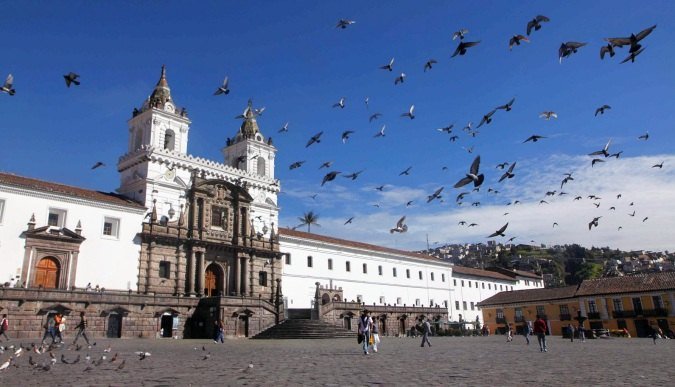
Most travelers need multiple continents to check off a UNESCO list. Ecuador lets you do it in one trip. From Andean colonial cities to living laboratories of evolution, here are five world-class destinations waiting for you.
1. Quito: the city that started it all
Perched high in the Andes at 2,850 meters, Ecuador’s capital holds a unique distinction: it was one of the very first cities in the world to receive UNESCO World Heritage recognition in 1978. The reason is immediately clear. Quito’s historic center, one of the largest and best-preserved in Latin America, is a seamless weave of colonial architecture, indigenous artistry, cobblestone streets, and gilded baroque churches that have stood for centuries. Walking through it feels less like sightseeing and more like stepping into living history.
2. Cuenca: Andean elegance at its finest
Recognized by UNESCO in 1999, Cuenca is arguably Ecuador’s most beautiful city. Its pastel-colored facades, flower-filled markets, and cathedral domes reflected in the Tomebamba River give it an almost storybook quality. Beneath that charm lies a deep cultural richness rooted in Andean tradition, from its renowned straw hat artisans to its vibrant arts scene. Cuenca rewards slow travel.
3. Galápagos Islands: where evolution is on display
Few places on earth have shaped our understanding of life itself. Designated a Natural World Heritage Site in 1978 and a UNESCO Biosphere Reserve in 1984, the Galápagos remain one of the planet’s most extraordinary ecosystems, home to species found nowhere else, in landscapes that have changed little since Charles Darwin arrived in 1835. Whether above or below the waterline, the islands are a constant reminder of nature’s ingenuity.
4. Qhapaq Ñan: the road that built an empire
Long before modern infrastructure, the Incas engineered one of history’s most ambitious road networks: the Qhapaq Ñan, stretching thousands of kilometers from the snow-capped Andes to the Pacific coast, connecting communities across six countries for trade, communication, and governance. Declared a UNESCO World Heritage Site in 2014 through an unprecedented joint nomination by all six nations it crosses, this ancient highway is as much a feat of diplomacy as it is of engineering.
5. Sangay National Park: wilderness at its most untamed
Deep in Ecuador’s Amazon foothills, Sangay National Park is a world unto itself. Two active volcanoes anchor a landscape that shifts dramatically from tropical rainforest to glacial peaks, sheltering rare species including the Andean condor and the elusive mountain tapir. Its remoteness is precisely what has kept it pristine. UNESCO recognized it in 1983, and it remains one of South America’s great wild frontiers.
Ecuador is one of the few destinations in the world where history, culture, and nature converge at this level and all within reach of a single journey. At My Tour EC, we craft experiences that bring each of these extraordinary places to life, tailored to the way you like to travel.